

Building Leadership Confidence Through Safe Role-Play and Simulation Learning
If you’re honest with yourself, how often do you avoid a tough conversation, delay a high‑stakes decision, or second‑guess yourself in front of your team—not because you lack knowledge, but because you’re not confident? But role-play can help.
You’re not alone.
In survey after survey, 50–60% of new and mid‑level leaders report feeling underprepared for the realities of their role. One global study of 28,000 leaders found that only about 40% rated their own leadership confidence as “high” when it came to handling conflict, influencing stakeholders, or leading change.
And yet, those same leaders are often thrown into the deep end: “Go lead the transformation. Don’t mess it up.”
That’s like asking someone to perform on stage without ever letting them rehearse.
This is where safe role‑play and simulation learning change the game.
When you give leaders a safe practice space—where they can try, stumble, adjust, and try again—leadership confidence stops being something you hope for and starts being something you deliberately build.
In this article, we’ll unpack how you can use role‑play, simulations, and safe‑to‑fail environments to build real, durable leadership confidence. We’ll lean on research, real‑world examples, and practical steps you can use immediately—whether you’re developing yourself, your team, or your entire organization.
Why Confidence Is the Real Bottleneck in Leadership Growth
Let’s get one thing clear: lack of confidence is not the same as lack of competence.
I’ve worked with leaders who had all the right knowledge—books read, frameworks memorized, strategy slides mastered—yet still froze when the CFO challenged them in a meeting, or when a top performer confronted them about unfair workloads.
They didn’t need more theory.
They needed more reps.
Research backs this up. According to a meta‑analysis on simulation‑based training in leadership and teamwork by Eduardo Salas and colleagues in the Journal of Applied Psychology (Salas et al., 2020), well‑designed simulations can significantly improve not just skills, but also self‑efficacy—which is essentially confidence that “I can do this.”
In other words, the more realistic practice you get in safe conditions, the more your brain starts believing: I’ve seen this before. I can handle this.
That belief is the foundation of leadership confidence.
The Confidence Gap Most Organizations Ignore
Here’s the reality: most organizations develop leaders in a way that’s backward.
They:
- Promote high performers into leadership roles
- Give them a two‑day training
- Hand them a team and a big mandate
- Expect them to “figure it out on the job”
No wonder a study from McKinsey found that only 11% of organizations believe their leadership development programs achieve desired outcomes consistently. And in their research on simulations and accelerated development, McKinsey consultants Aaron De Smet and colleagues argue that experiential, simulation‑driven learning is one of the most effective ways to close that gap (McKinsey & Company, 2022).
Think about it like this.
You’d never:
- Let a pilot fly a commercial plane without hours of simulator time
- Let a surgeon operate without practicing on models, simulations, and supervised cases
But we routinely let leaders “operate” on real people, real budgets, and real careers with almost no meaningful practice.
That’s the gap safe role‑play and simulation learning are designed to close.
The Science: Why Safe Role‑Play Builds Leadership Confidence Faster
You might be thinking: “Role‑play? Really? Isn’t that just awkward training-room theater?”
Done badly, yes.
Done well, role‑play is one of the most powerful confidence building tools we have.
Let’s anchor this in the research for a moment.
Psychological Safety: The Hidden Ingredient
A key concept here is psychological safety—the belief that you can speak up, make mistakes, and experiment without fear of embarrassment or punishment.
Paul A. O’Neil and colleagues, in a study on experiential learning and leadership development in the Academy of Management Learning & Education, found that simulations and role‑plays only translate into real learning when participants feel psychologically safe enough to take risks and be vulnerable (O’Neil et al., 2019).
That’s critical for role‑play confidence.
If leaders feel like they’re being judged, scored, or exposed, they’ll default to playing it safe. They’ll perform a version of themselves they think looks good, instead of stretching into new behaviors that feel uncomfortable at first.
In other words, no safety = no growth.
Deliberate Practice, Not Random Practice
There’s another layer: deliberate practice.
Michael D. Watkins and Herminia Ibarra, writing in MIT Sloan Management Review, make the case that leadership is best developed through deliberate practice, and that role‑play is one of the best tools we have for that (Watkins & Ibarra, 2023).
Deliberate practice means:
- Focusing on specific, high‑value behaviors (like giving tough feedback)
- Practicing them repeatedly in varied situations
- Getting immediate, targeted feedback
- Adjusting and trying again
That’s exactly what a well‑designed simulation or role‑play can do.
One more data point: a meta‑analysis of simulation‑based training (again, Salas et al., 2020) found that simulations not only improved performance, but their impact was strongest when feedback and reflection were built in. That’s where confidence really locks in.
You’re not just acting. You’re learning about how you act—and how to act more effectively.
What “Safe Practice” Really Means (And What It Doesn’t)
Let’s define something clearly, because this is where a lot of leaders and L&D teams get it wrong.
Safe practice doesn’t mean:
- Avoiding discomfort
- Protecting egos
- Making everything easy
Safe practice means you can experience discomfort without damage.
You still feel challenged. You still feel exposed. You just don’t pay the real‑world price for mistakes.
It’s the difference between practicing a speech in your living room and giving it live at your company’s all‑hands. You want the pressure of performance, but not the irreversible consequences.
The Three Pillars of a Safe Role‑Play Environment
In my experience—and this lines up with what I’ve seen in the research—effective safe practice for leadership confidence rests on three pillars:
1. Clear Intent
Everyone knows why they’re here: to practice and grow, not to impress or perform. You make it explicit that the purpose is confidence building through experimentation, not evaluation.
2. Protected Space
What happens in the simulation stays in the simulation. You’re not using this to rank people or write their performance reviews. People need to know that failures in this environment are data, not ammunition.
3. Constructive Feedback
Feedback is specific, behavior‑focused, and balanced. According to a piece in Harvard Business Review by Deborah Rowland and Thomas J. Tierney, leaders grow faster when they can “see themselves in the mirror” through feedback that reflects both strengths and blind spots (Rowland & Tierney, 2021). That’s where real role‑play confidence starts to build.
When those three are present, something powerful happens:
Leaders stop trying to “look good” and start trying to get better.
Become the leader you desire
Start your journey in becoming a
leader according to your personal and
professional goals. Sign-up for a free trial and start your learning path.
Start your journey in becoming a leader according to your personal and professional goals. Sign-up for a free trial and start your learning path.
How Role‑Play and Simulation Learning Actually Build Confidence (Step by Step)
Let’s make this practical. How do safe role‑plays and simulations turn nervous, hesitant leaders into confident, grounded ones?
I’ll walk through the mechanics, then we’ll talk about how to design this inside your team or organization.
Step 1: Simulate Real Pressure Without Real Risk
The first big lever is exposure to pressure.
You build leadership confidence the same way athletes build clutch performance: by simulating pressure again and again until your nervous system says, “Oh, I know this. I’ve been here before.”
For example, imagine a simulation where:
- You’re playing a manager who has to tell a long‑tenured team member that their role is changing
- The “employee” is played by a trained actor or a colleague following a script with emotional responses
- You have limited time, incomplete information, and conflicting priorities
The stakes feel high.
Your heart rate goes up. You worry about saying the wrong thing.
But after the role‑play, you get debriefed. You rewind specific moments. You get feedback on your tone, your pacing, your word choice. You see the impact your behavior had on the other person.
Then you do it again, with a slight twist.
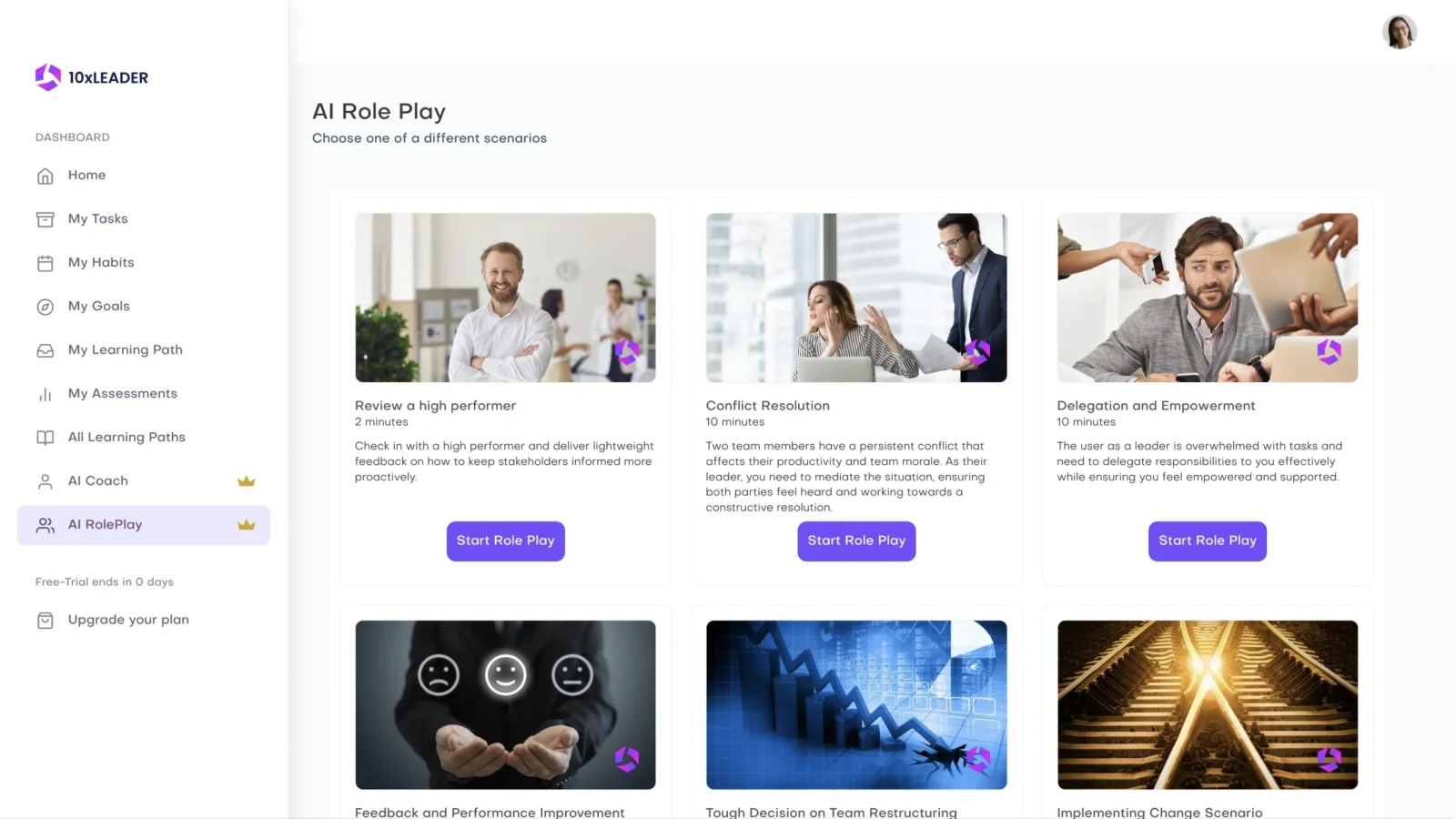
That’s not theory. That’s simulation learning and how it is implemented at 10xLeader.
Over time, your brain codes these experiences as familiarity. The next time you’re facing a real employee in a similar situation, your inner dialogue shifts from “I have no idea how this will go” to “I’ve done this before in practice and survived. I know the moves.”
That’s leadership confidence in action.
Step 2: Turn Vague Anxiety into Specific Skills
A lot of leaders carry vague fears:
- “I’m not good at conflict.”
- “I don’t know how to say no.”
- “I’m not a natural leader.”
The problem with vague fears is you can’t practice your way out of them. They’re too general.
Role‑play and safe practice force you to get specific.
For instance, after a role‑play, you might realize:
You avoid silence by talking too much
- You soften your message so much it becomes unclear
- You default to a defensive posture when challenged
Now you have specific behaviors to work on.
That’s a huge shift.
Once you know, “I tend to avoid eye contact when delivering tough feedback,” you can design targeted practice to change that. You’re no longer trying to “be more confident” in some abstract way. You’re adjusting observable behaviors.
Confidence follows competence.
Step 3: Build a Feedback Loop That Reinforces Progress
Confidence is built on evidence.
If all you have is one big, scary experience that didn’t go well, your brain will use that as a reference point and say, “See? You’re not good at this.”
Safe practice flips that script.
Every time you step into a simulation, try a new behavior, and get feedback, you’re collecting micro‑evidence:
- “When I paused and asked an open question, the tension went down.”
- “When I named the elephant in the room, people respected me more, not less.”
- “When I set a clear boundary, the world didn’t end.”
These are tiny, but they add up.
Over time, this evidence stack becomes your internal proof that you can handle these situations. That proof is the foundation of durable leadership confidence.
Designing Safe Role‑Play for Your Team (Without Making It Awkward or Fake)
Let’s get into the “how.”
How do you design role‑play and simulation learning inside your organization so it genuinely drives confidence building—and doesn’t just become another awkward training exercise everyone rolls their eyes at?
Start with Real Moments That Matter
First, you need to anchor your simulations in real leadership moments that happen in your context.
Ask yourself (or your leaders):
- Where do you feel the most anxious or unsure?
- Which conversations do you put off?
- Which meetings do you dread?
- Where do you leave thinking, “I should’ve handled that differently”?
Typical candidates:
- Giving tough feedback to a high performer
- Pushing back on a senior stakeholder
- Leading a change announcement with a skeptical team
- Addressing underperformance or burnout
- Saying no to unrealistic demands
Those are your raw materials for scenarios.
The more real they feel, the more your simulation learning will transfer back to daily work.
Script the Situation, Not the Performance
One of the biggest mistakes I see in role‑play is over‑scripting.
You don’t want people to read lines. That kills authenticity.
Instead, script:
- The context (what’s happening, who’s involved, what’s at stake)
- The objectives for each role (what the “employee” wants, what the “leader” needs to achieve)
- A few likely emotional beats or reactions
Then let people be themselves.
The goal is to create a realistic, emotionally charged context—not to force people into artificial dialogue.
Set the Rules for Psychological Safety Up Front
This is non‑negotiable if you want real role‑play confidence gains.
Before you start, make it explicit:
- This is a learning space, not an evaluation space
- Mistakes are valuable data, not failures
- We focus on behaviors, not personalities
- Everyone in the room is here to help each other get better
You’d be surprised how much it helps just to say out loud: “You’re not being graded. You’re practicing.”
Research from O’Neil et al. underscores this—participants in simulations learn and retain more when they feel safe to experiment.
Keep the Scenarios Short, Then Debrief Deep
Another trap: long, meandering role‑plays that drain energy and get unfocused.
In my experience, you get more confidence building from short, intense scenarios plus rich debriefs than from dragging a single role‑play out for 30–40 minutes.
Aim for:
- 7–12 minutes of role‑play
- 10–20 minutes of debrief and feedback
In the debrief, ask:
- How did you feel at different moments?
- What did you notice about your own behavior?
- What worked better than you expected?
- Where did you feel yourself avoid or retreat?
- What would you try differently next time?
This is where leadership confidence actually grows—in the reflection, not just in the performance.
Real‑World Example: How a Simple Simulation Shifted a Leader’s Confidence
Let me share a quick story.
I worked with a mid‑level leader—we’ll call her Sarah—who’d just taken over a team of 12. She was smart, driven, and respected. But she hated conflict. Her biggest fear? Giving tough feedback to a long‑tenured team member who was well‑liked but underperforming.
She’d been avoiding the conversation for months.
We designed a simple simulation:
- Scenario: Sarah has a 30‑minute 1:1 with this team member to address performance issues
- Role‑play: The “employee” was played by a colleague given a loose script (defensive at first, then emotional, then resigned)
- Objective: Deliver clear feedback, agree on a performance plan, and maintain the relationship
In the first run, Sarah:
- Softened the message
- Spent most of the time talking instead of listening
- Backed away from clear expectations when the “employee” got emotional
Afterward, we debriefed. She saw it. She didn’t need us to tell her—it was obvious once she reflected.
So we ran it again.
This time, she:
- Led with empathy but got to the point faster
- Asked more open questions
- Held her ground when the “employee” tried to deflect
The shift wasn’t perfect, but it was real.
Two weeks later, she had the actual conversation with her real team member. Was she anxious? Absolutely. But she wasn’t paralyzed. She’d already “lived” a version of this meeting in a safe practice environment.
Her words afterward:
> “It wasn’t easy, but I wasn’t guessing. I felt like I knew how to walk into it. I wasn’t hoping it would go well—I was prepared.”
That’s the essence of role‑play confidence.
Next Steps: How to Start Building Leadership Confidence Safely, Now
If you’ve read this far, you probably know instinctively that you—or your leaders—need more than theory.
You need safe practice.
You need reps.
You need simulation learning that mirrors the real challenges you face, without the real‑world downside.
Here’s how to start, practically:
1. Pick One Leadership Moment You Avoid
Maybe it’s giving tough feedback. Maybe it’s saying no to unrealistic requests. Pick one.
2. Design a Simple Scenario Around It
Write 3–4 sentences of context. Define roles. Clarify the objective.
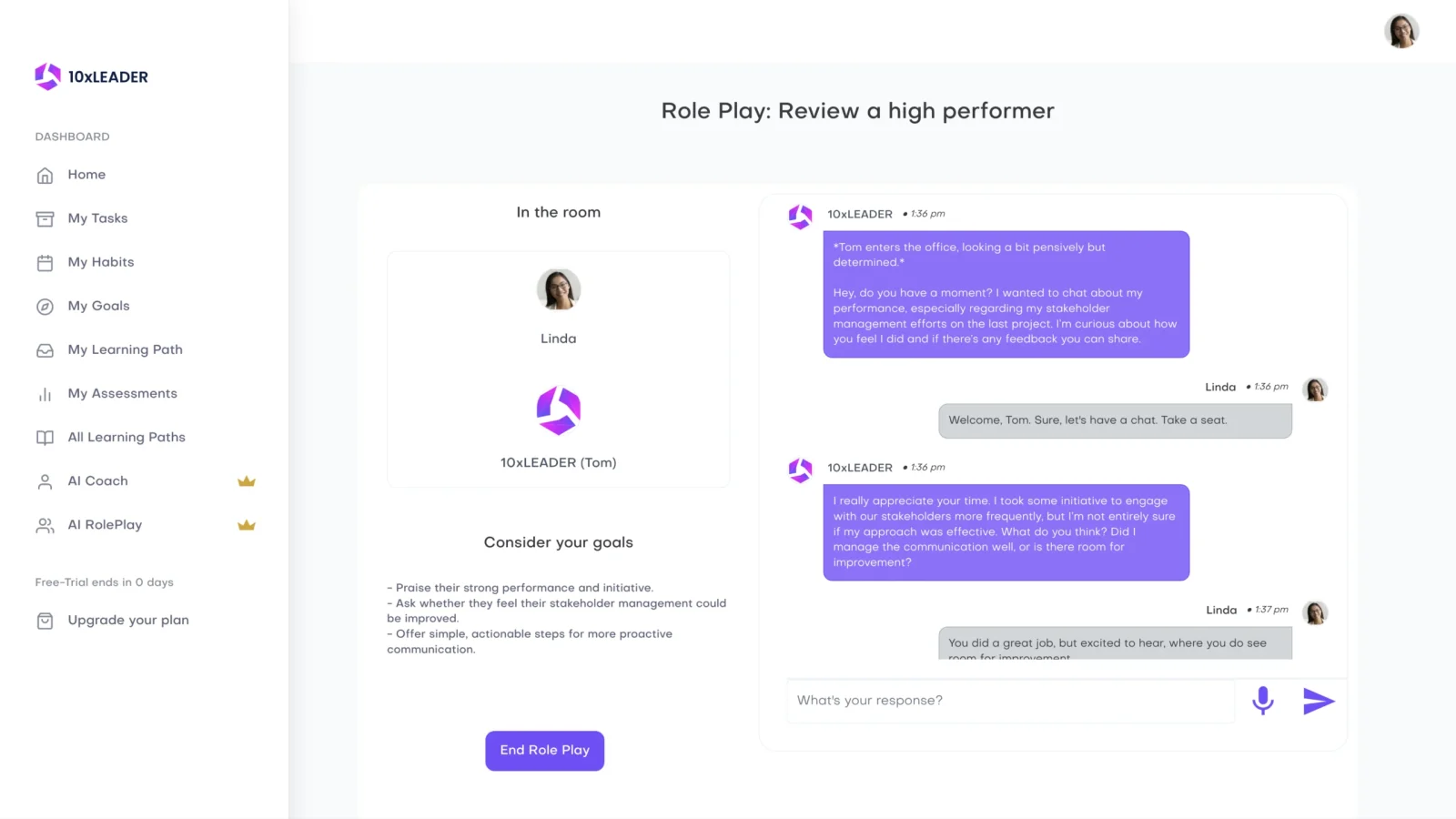
3. Run a 10‑Minute Role‑Play with a Colleague or Coach or 10xLeader AI Role Play
Don’t overthink it. Just run it. Then debrief: what worked, what didn’t, what you’ll try differently.
4. Repeat Weekly for a Month
Same theme, different variations. You’ll be stunned by how much your role‑play confidence grows in just four weeks.
5. Layer in Tools and Support
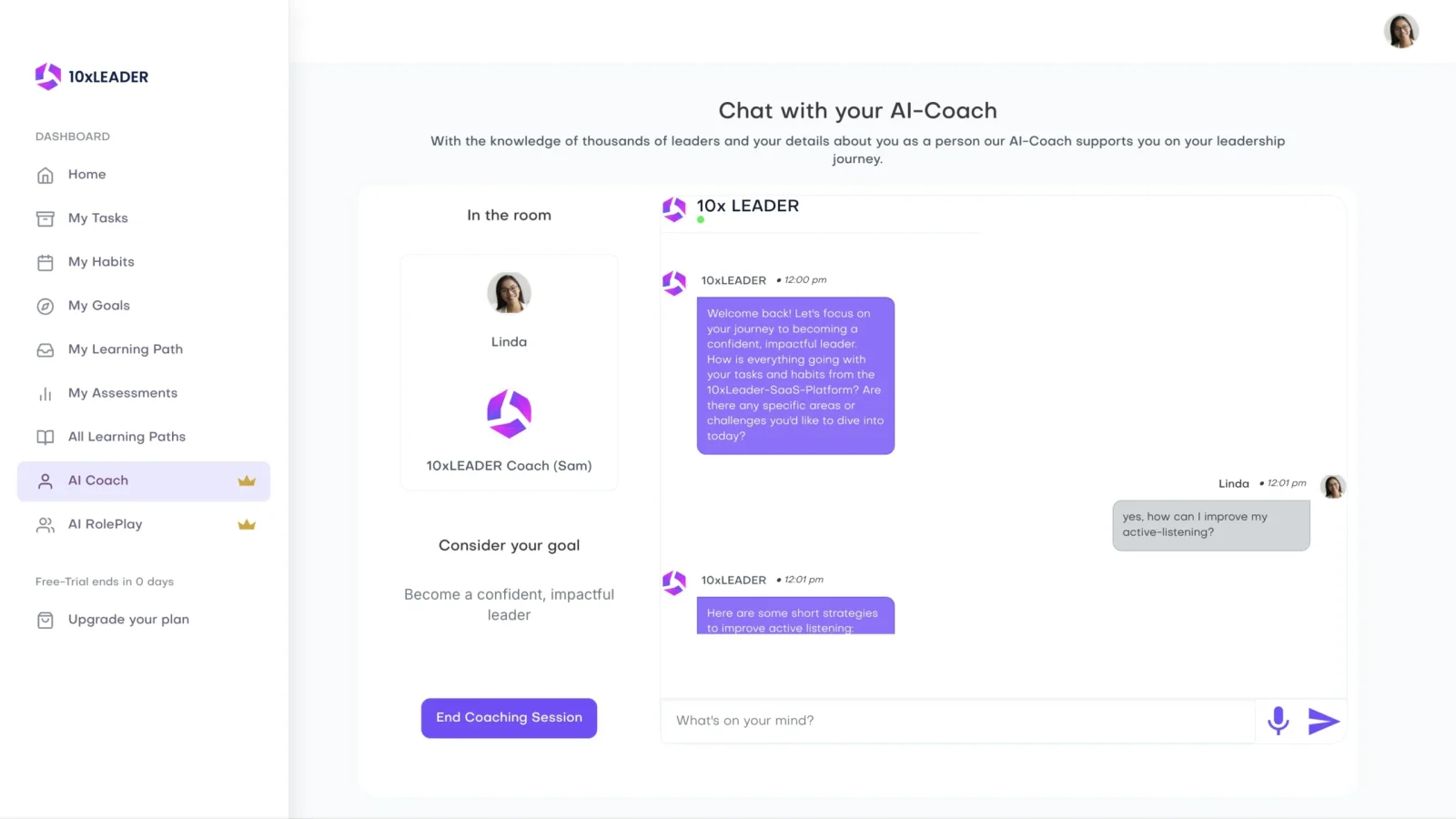
Use simple frameworks, prompts, or guided reflection. If you want structured, bite‑sized support, explore platforms like 10xLeader that focus on leadership growth in just minutes a day, with scenarios and guided practice built in.
The truth is, leadership confidence is not a personality trait you either have or don’t. It’s a trainable capability.
And safe role‑play is one of the most practical, research‑backed ways to train it.
Final Thought: Confidence Comes After the Leap, Not Before
A lot of leaders secretly wait for confidence to show up before they step into bigger conversations, bigger decisions, bigger roles.
It doesn’t work that way.
Confidence doesn’t come first. Practice comes first.
You practice—in safe environments where you can fail without fallout. You learn. You adjust. You practice again. That’s how your nervous system, your skills, and your identity catch up.
Role‑play and simulation learning simply accelerate that cycle.
So if you want to build leadership confidence—for yourself, your team, or your entire organization—don’t just send people to another course and hope.
Give them a stage to rehearse on, not just a script to read.
Start small. Make it safe. Keep it real. And commit to the reps.
That’s how you turn “I hope I can handle this” into “I know I can handle this.”
That’s how you build 10x leaders.
Table of Contents
Empower Your Leadership Journey with Innovation
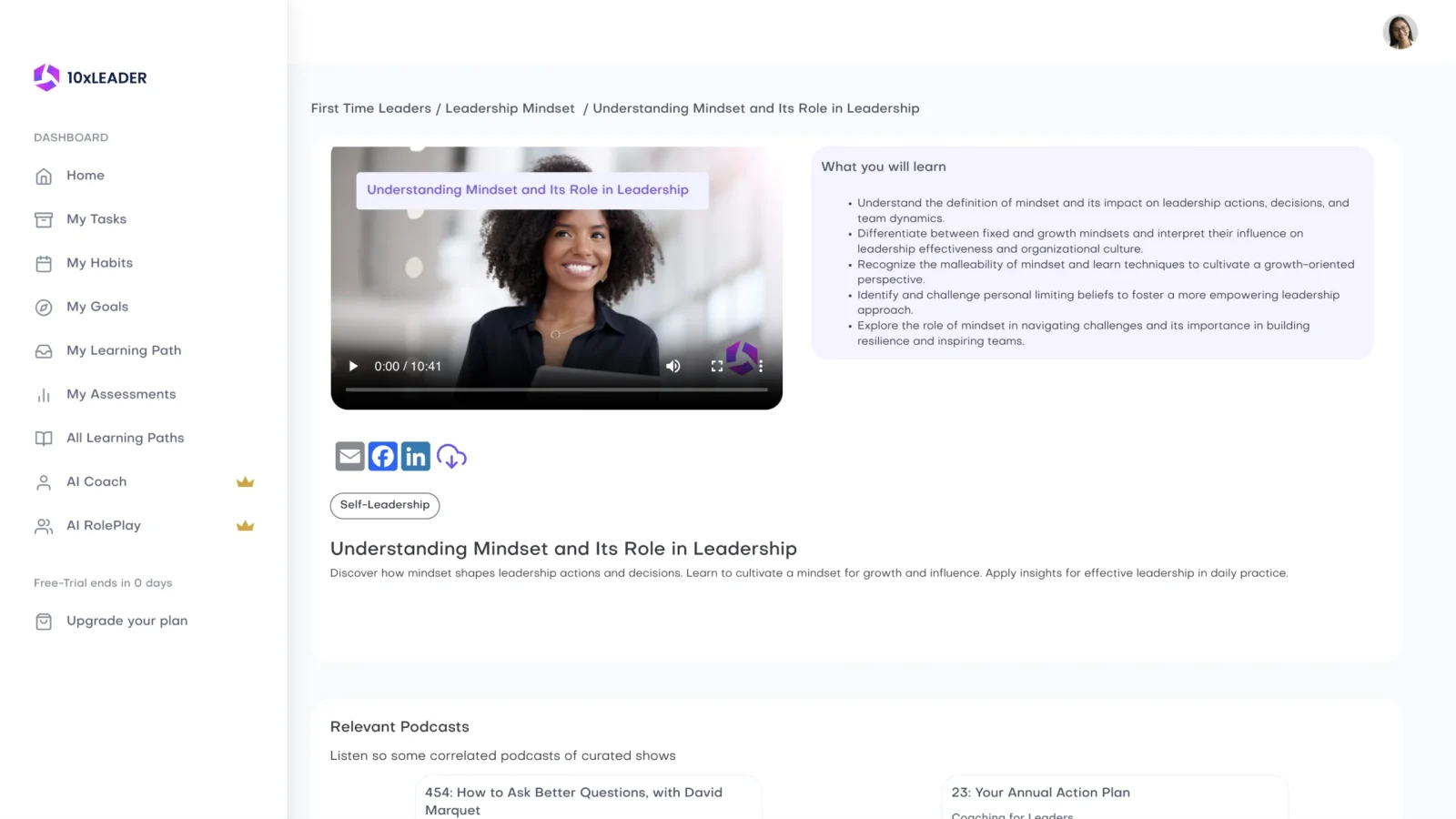
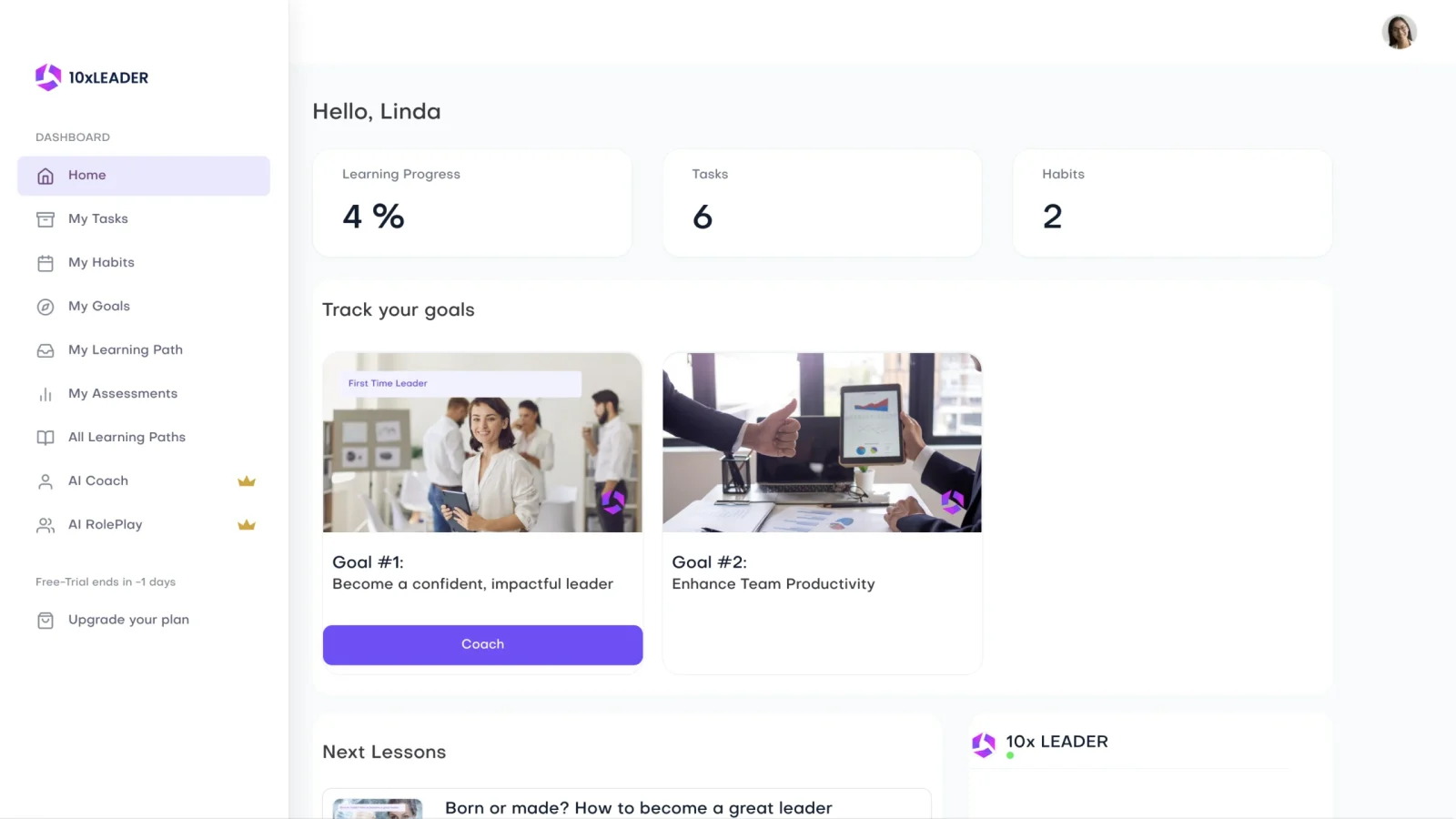
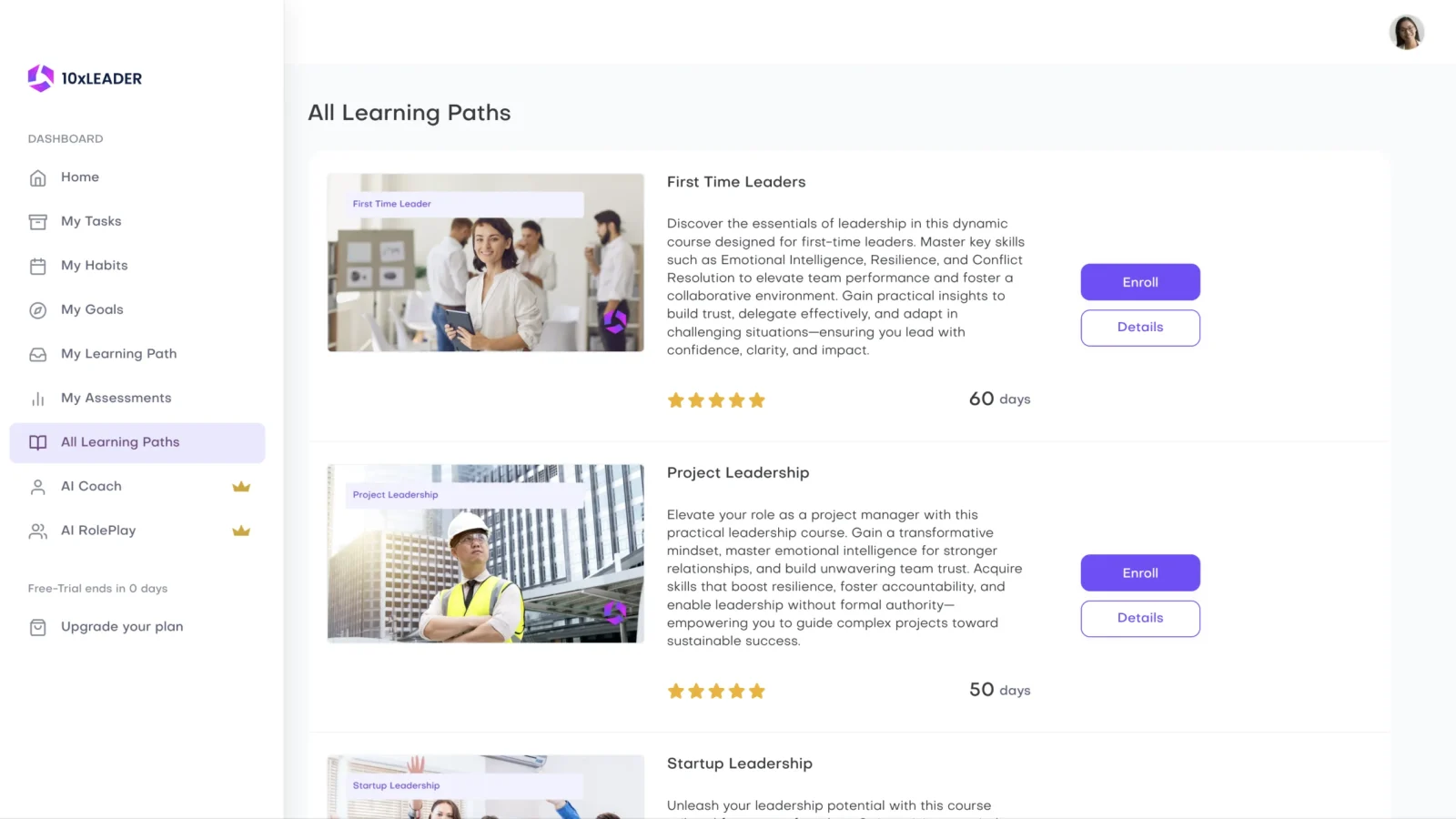
Start your journey with 10xLEADER's innovative features—AI-driven coaching, personalized learning paths, and actionable habits—to redefine leadership in a fast-paced world.


Markus Hofer
C-Level Executive⎥Tech-Enthusiast⎥Lecturer⎥Author ⎥Researcher
Markus Hofer is lecturer at several universities and C-Level Executive in a large corporate. Markus published several books in the field of leadership. His current research project is about AI and leadership. With more than two decades of leadership experience he often writes articles about leadership and management.

Future Leadership Learning: Trends for 2026+
Discover future leadership trends for 2026. Learn how microlearning and AI are transforming leadership evolution. Prepare for the future now!

Leadership Development for Start-Up Founders
Discover essential leadership skills for start-up founders to scale your business confidently. Learn how to overcome growth challenges effectively.

AI vs Human Coaching: Mastering the Hybrid Model
Discover how a hybrid coaching model combining AI and human expertise can enhance leadership coaching and boost your team's success.

Lead with Purpose: Align Vision, Values & Culture
Discover purpose-driven leadership by aligning vision, values, and culture for meaningful impact. Boost engagement and teamwork today.
